Showing posts with label identity theft. Show all posts

Wednesday, April 18, 2007

COM125 Assignment 12: Trust: What It All Comes Down To

Within the content of this course, Intro to the Internet (COM125), just about everything interrelates. I especially think so when the topics were covering such material as internet privacy, identity, and online community. To me, an underlying message was present communicating the similarity of these three very different, yet similar subjects.

Online communities have become more prominent with the increasing growth of the internet over the past ten to fifteen years. Whatever your interests or beliefs may be, there is an online community waiting for you to support their same ideas or be there for you when you may think you are a loner in that particular area. A sense of community and belonging is very important for an individual's mental state. It keeps them stable as well as provides them with a sense of comfort which is necessary to be in the back of someone's mind. Essentially, this is a type of 'support system' allowing the individual or individuals to express themselves freely without criticism from those closest to them. Fernback and Thompson (1995) write, "[Community] refers to a sense of common character, identity or interests." "Community becomes so thin because workplace and residence, production and consumption, identity and interests…." The internet has really done just the opposite for what Fernback and Thompson have expressed today's culture have done to community; it has brought back togetherness and common interest in people of all geographic locations of the world.
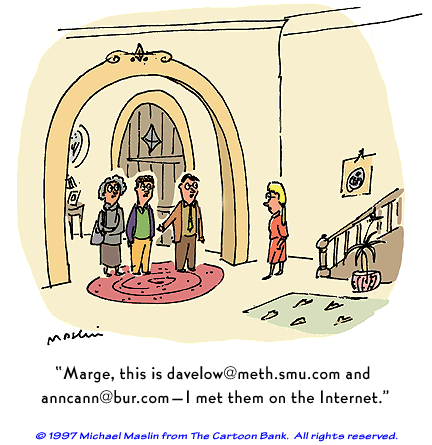


So where do the topics of identity and privacy fit into online community? Well, when exposed to an online community, in which one participates or belongs to, they essentially create their own identity which depends on their thoughts of privacy. One may create a pseudonym, or false name, to disguise their real identity. These pseudonyms are very important in the safety of online user's personal information. As discussed in an earlier blog, it is not very difficult to gain access to someone's credit card information, social security numbers, and so forth, if someone is trained in doing that sort of criminal activity. Therefore, people disguise their real information in hopes that it will better protect themselves from identity theft and other crimes. These disguises should not be harmful in the trickery and false leading of others however. Donath (1996) writes, "Some [forms of identity deception] are quite harmful to individuals or to the community; others are innocuous, benefiting the performer without injuring the group. Some are clearly deceptions, meant to provide a false impression; others are more subtle identity manipulations, similar to the adjustments in self-presentation we make in many real world situations." When someone has belonged to an online community for some time, and has become comfortable with the community itself, they may be prone to disclose more personal information than is necessary. It is important to not do this because online identity thefts can gain access to any website at any time if they want to. Wikipedia writes, "Regular Internet users with an eye to privacy may succeed in achieving a desirable level of privacy through careful disclosure of personal information and by avoiding spyware." Major challenges of maintaining privacy are heavily due to technology such as cookies, IP addresses, and spyware.

Principally, when exposed or part of an online community in which one feels comfortable with the information and population of the community, they protect their personal information, their identity, through certain types of privacy. What it all comes down to is trust. Do I trust this online community in which gives me support with my real name and so forth? Evaluation of trust vs. risk is the underlying message throughout the topics of online community, privacy, and identity.

References:

Donath, J. S. (1996, November, 12). Identity and Deception in the Virtual Community. Communities in Cyberspace, Retrieved April 18, 2007, from http://smg.media.mit.edu/people/Judith/Identity/IdentityDeception.html

Fernback, J., & Thompson, B. (1995). Virtual Communities: Abort, Retry, Failure?. Retrieved April 18, 2007, from http://www.rheingold.com/texts/techpolitix/VCcivil.html.

Internet privacy. (2007, April 15). In Wikipedia, The Free Encyclopedia. Retrieved 16:34, April 18, 2007, from http://en.wikipedia.org/w/index.php?title=Internet_privacy&oldid=123076810

Wednesday, February 21, 2007

COM125 Week 5: Identity: Unknown


I absolutely love when someone is setting up a new e-mail account or developing a new screen name for AOL Instant Messenger and it takes that person a good couple hours to make sure their identification name is perfect and suites them. I understand why this is a process that people often do not just dive right into. According to Masum, "Since there is no absolute objective reputation quantity stamped on people’s foreheads, measurable proxies are necessary…." Often times, people want to associate something positive or interesting about themselves into their user name that sets them apart from everyone else. A person's user name is very important; it is the first thing that someone sees when talking that person over the internet, and/or is the first name that comes up when receiving an e-mail. The internet proposes more risk to a person's identity than something off the internet does. What I mean by this is that over the internet, there are a million and one ways people can find information about you and gain access to all of your personal things, and people have certainly done this. This is the reason people create these "identification names" in the first place, to protect themselves from fraud and unnecessary information exchange.

With managing school, work, and a social life, I have developed many online user names in the past. Currently, for talking to my friends on the internet and sending e-mail to my friends and family, I use the identification of 'NooCH717'. This may not mean anything to a lot of people but to me, it is what I have been called by certain family and friends for a long time now and I like the fact that when I am on the internet chatting, it reminds me of my family and friends calling me by this nickname. I do not have a strong interest in online gaming or anything of that sort so my identification name essentially is between me, my family, and my friends. With more professional matters such as school and work, my identification name is just 'djlisi'. Keeping this plain and simple allows me to appear professional and proficient. For example, if I was at an interview for a part-time job and was asked to fill out some paperwork containing my e-mail address, name, address, etc, and in the box for e-mail I wrote: 'HotLaXPartier6969', I feel this would set me off on the wrong foot professionally and would give people reason to prejudge me or think twice about hiring me. When thinking about online user names and identification names, often times people think of reputations associated with them but also, people need to realize that before the reputation came the first impression.

Honestly, I really do not think it would be that difficult to obtain someone else's identification. Look at the number of people on MySpace and Facebook alone that reveal extremely personal information such as their phone numbers, addresses, hometowns, where they attend school, work information, and so on and so on. Plugging that information into a system I am sure people can find banking information easily with a little research, car information, etc. Let us just take one example to prove my point. Say someone knows your school e-mail address. If you have not personalized your password, it is something that is not hard to get a hold of. At Buffalo, passwords are simply the first four digits of your birthday and the last six digits of your UB card. Personally, I do not think this is a very efficient way to pass out passwords to students. Even though many students SHOULD change their passwords immediately, many do not because of various reasons. In gaining someone's UBit name and password, you have access to their grades, schedule, e-mail and many other personal accounts of a college student. According to Forbes.com, "New identity verification and authentication technologies will provide further security, although the rollout and networking of these devices will take time." I think many companies releasing this information technologies are learning as we are that there are always going to be new ways hackers and identity thefts can gain access to information which explains the time factor.

Creating online identities in a respectable fashion is a great way to not disclose personal information that could be picked up by anyone over the internet. One needs to be careful yet aware that their online identity however, can define a perception of how people view them.


References

Donath, J. (1996). Identity and Deception in the Virtual Community. Retrieved February 21, 2007, from http://smg.media.mit.edu/people/Judith/Identity/IdentityDeception.html

Forbes Inc. (April 2005). Hooked on Phishing. Retrieved February 21, 2007, from http://www.forbes.com/business/2005/04/29/cz_0429oxan_identitytheft.html

Masum, Hassan and Zhang, Yi–Cheng. (July 2004). Manifesto for the Reputation Society First Monday, volume 9, number 7. Retrieved February 21, 2007, from http://firstmonday.org/issues/issue9_7/masum/index.html