Showing posts with label privacy. Show all posts

Wednesday, April 18, 2007

COM125 Assignment 12: Trust: What It All Comes Down To

Within the content of this course, Intro to the Internet (COM125), just about everything interrelates. I especially think so when the topics were covering such material as internet privacy, identity, and online community. To me, an underlying message was present communicating the similarity of these three very different, yet similar subjects.

Online communities have become more prominent with the increasing growth of the internet over the past ten to fifteen years. Whatever your interests or beliefs may be, there is an online community waiting for you to support their same ideas or be there for you when you may think you are a loner in that particular area. A sense of community and belonging is very important for an individual's mental state. It keeps them stable as well as provides them with a sense of comfort which is necessary to be in the back of someone's mind. Essentially, this is a type of 'support system' allowing the individual or individuals to express themselves freely without criticism from those closest to them. Fernback and Thompson (1995) write, "[Community] refers to a sense of common character, identity or interests." "Community becomes so thin because workplace and residence, production and consumption, identity and interests…." The internet has really done just the opposite for what Fernback and Thompson have expressed today's culture have done to community; it has brought back togetherness and common interest in people of all geographic locations of the world.
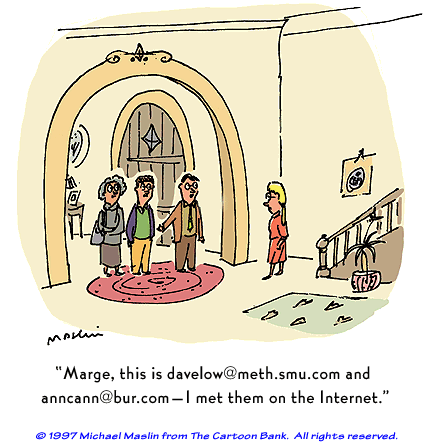


So where do the topics of identity and privacy fit into online community? Well, when exposed to an online community, in which one participates or belongs to, they essentially create their own identity which depends on their thoughts of privacy. One may create a pseudonym, or false name, to disguise their real identity. These pseudonyms are very important in the safety of online user's personal information. As discussed in an earlier blog, it is not very difficult to gain access to someone's credit card information, social security numbers, and so forth, if someone is trained in doing that sort of criminal activity. Therefore, people disguise their real information in hopes that it will better protect themselves from identity theft and other crimes. These disguises should not be harmful in the trickery and false leading of others however. Donath (1996) writes, "Some [forms of identity deception] are quite harmful to individuals or to the community; others are innocuous, benefiting the performer without injuring the group. Some are clearly deceptions, meant to provide a false impression; others are more subtle identity manipulations, similar to the adjustments in self-presentation we make in many real world situations." When someone has belonged to an online community for some time, and has become comfortable with the community itself, they may be prone to disclose more personal information than is necessary. It is important to not do this because online identity thefts can gain access to any website at any time if they want to. Wikipedia writes, "Regular Internet users with an eye to privacy may succeed in achieving a desirable level of privacy through careful disclosure of personal information and by avoiding spyware." Major challenges of maintaining privacy are heavily due to technology such as cookies, IP addresses, and spyware.

Principally, when exposed or part of an online community in which one feels comfortable with the information and population of the community, they protect their personal information, their identity, through certain types of privacy. What it all comes down to is trust. Do I trust this online community in which gives me support with my real name and so forth? Evaluation of trust vs. risk is the underlying message throughout the topics of online community, privacy, and identity.

References:

Donath, J. S. (1996, November, 12). Identity and Deception in the Virtual Community. Communities in Cyberspace, Retrieved April 18, 2007, from http://smg.media.mit.edu/people/Judith/Identity/IdentityDeception.html

Fernback, J., & Thompson, B. (1995). Virtual Communities: Abort, Retry, Failure?. Retrieved April 18, 2007, from http://www.rheingold.com/texts/techpolitix/VCcivil.html.

Internet privacy. (2007, April 15). In Wikipedia, The Free Encyclopedia. Retrieved 16:34, April 18, 2007, from http://en.wikipedia.org/w/index.php?title=Internet_privacy&oldid=123076810

Thursday, February 15, 2007

COM125 Week 4: Are you stalking me?


When I think about privacy, I think about my everyday life and how it would be affected if privacy were a luxury of the past. Our twenty-first century lifestyle of 'wireless' this and 'easy access' that, has us on the internet a good portion of our time throughout a typical week. When thinking about a usual day in my life, I want privacy: when I am getting out of the shower and getting dressed, when I am studying, doing homework, reading, on my cell phone, going to the bathroom, and so on…. That is a lot of privacy, and that is only looking at one day out of the thousands I have already spent on this earth. I would define privacy as anything or anytime the seclusion of myself or information regarding myself is intended to be without disturbance or intrusion. Providing this definition, do people today, given their 'everything internet' (dealing with more activities online than not) lives, think about the internet as something they need to be protected from? According to Sullivan, "The simple act of surrendering a telephone number to a store clerk may seem innocuous." How many times have we set up accounts online where we give our names, addresses, and phone numbers? I am sure many, and why do we half of the times not think twice about disclosing this personal information over the internet which reaches millions of people everyday? This information for all we know could be given to hackers, credit card thieves, or other people or places that pose a threat. I believe the internet is a great place like any other, but any great place has a few problem areas which need to be brought to people's attention and looked after.

Why is it that every time I open my e-mail account and sign in under a secure location that several e-mails in my inbox read, "Hi Dominick, we have the perfect car for you!" or "Hi Dominick, want to increase your penis size?" or "Dominick, Buffalo has a lot to offer, visit our website to find out what you've been missing!" It is like the companies behind these personalized e-mails search out and finds my e-mail address and the name of the person that has access to that e-mail account, where I live, and anything else that relates to me. I might first admit that when I am online, I do not always take every precautionary measure in fully protecting myself. According to Wikipedia, the answer to this rather puzzling question could be, "On the Internet, certain organizations employ profiling of people's web browsing, collecting the URLs of sites visited. The resulting profiles may or may not link with information that personally identifies the people who did the browsing." I did not know that when I signed up for Road Runner high-speed internet, someone was going to be monitoring my every online mouse click! Why, or the better question might be how do certain organizations have the right to essentially stalk internet users? It is not that I didn't know what people will do for a little business and to make money, it is just that you never think something can happen to YOU personally.

As more and more e-mails kept entering my inbox, I was beginning to get annoyed. I decided to do a few things that would put me at less risk with fraud and would put me in a more comfortable atmosphere (what it should be) when I am on the internet. I updated my personal information on all of my internet accounts, and by updated I mean deleted. So far, I have not noticed a significantly less amount of e-mails involving my name probably because those company's information systems probably already have my personal data stored. What I can expect though, is that the number of these e-mails should not increase on a day-to-day basis and if I cannot win completely, at least I slowed them down or lead them away from my trail.

Looking at the internet in a privacy lane of vision, in some aspects it has become a place where hunters seek out the weakest link and strike when the moment is right. Even when spy protection programs are installed and internet users take all the necessary precautions in protecting their privacy, the internet, along with anything else in life, will always be outrun and out beat by those who find ways to overcome it.


References

Data privacy. (2007, February 8). In Wikipedia, The Free Encyclopedia. Retrieved 00:30, February 16, 2007, from http://en.wikipedia.org/w/index.php?title=Data_privacy&oldid=106538402

Internet privacy. (2007, February 14). In Wikipedia, The Free Encyclopedia. Retrieved 23:26, February 14, 2007, from http://en.wikipedia.org/w/index.php?title=Internet_privacy&oldid=108031912

Sullivan, Bob. (October 17, 2006) Privacy under attack, but does anybody care? MSNBC Interactive. Retrieved February 15, 2007 from http://www.msnbc.msn.com/id/15221095/